


Table of Contents
In my experience, sales is not about pitching.
It’s about understanding the prospect’s needs, pain points, and challenges.
Not what you assume they need.
What they actually tell you, if you ask the right questions.
Here’s the thing – most sales guys jump straight to the pitch. Hardworking guys, to be fair. Just in a hurry.
A bit like a chemist handing over medicine before the doctor has even examined the patient.
SPIN Selling works differently.
It’s not a script. It’s a sequence of questions, asked at the right time, in the right order.
The beauty of this approach?
It’s what takes you from being a postman dropping off a brochure to a doctor diagnosing before prescribing.
What is SPIN Selling?
SPIN Selling is a sales technique developed by Neil Rackham, focusing on four key question types: Situation, Problem, Implication, and Need-Payoff.
To be honest, the framework sounds simple.
It’s the execution that’s hard.
Most sales guys read the book once, nod along, and go back to their old habits within a week.
What SPIN really does is shift the conversation.
Away from “let me tell you about my product.”
Towards “let me understand your situation first.”
And this is where credibility gets built. Not by talking. By asking.
Research backs this up too – sales reps trained on the SPIN model showed close to a 17% improvement in sales results.
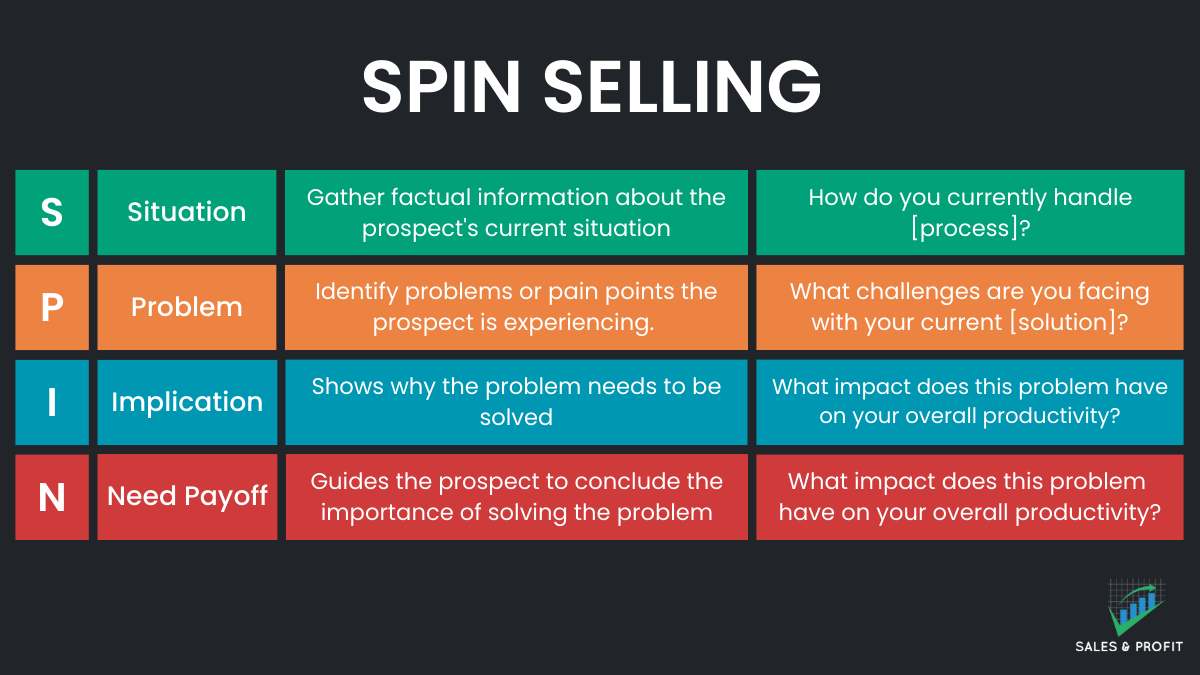
Here’s a brief explanation of each type of SPIN question
- Situation Questions: The groundwork questions. They help you understand where the buyer stands today. Nothing fancy here, just facts. Think of it as setting the stage before you go deeper.
- Problem Questions: Now you probe. What’s not working, and why. These are the questions that surface the issues your product or service can actually fix.
- Implication Questions: This is where it gets interesting. You help the prospect connect the dots on what happens if the problem stays unsolved. Not to scare them. To make the cost visible.
- Need-Payoff Questions: The vision questions. You get the prospect describing the upside themselves. Because when they say it out loud, they believe it. Not when you say it for them.
Here’s what I’ve noticed after years of B2B complex selling.
The moment you start asking SPIN questions well, something shifts.
You stop being the order taker. You become the trusted advisor.
Did your credibility go up, down, or remain the same on that last call?
That’s the real scorecard, not whether you “closed.”
One caveat though (and I could be wrong here) – this isn’t a script to be read word to word.
It’s a conversation. Natural, not an interrogation.
Ask a question that doesn’t fit the moment, and the prospect feels it immediately.
70+ SPIN Questions Examples
Let me share over 70 SPIN questions you can use as a starting point.
Not a script. A starting point.
Adapt them to your prospect, your industry, your deal.
1. Situation Questions
These are the fact-finding questions.
Where the buyer stands today – team, tools, process.
Here’s the thing though – most sales guys overdo these.
Every extra one is a minute you’re not spending on their pain.
If it’s on their LinkedIn or their website, don’t ask it on the call.
Keep this stage short. Three to five questions, no more.
- “What’s your current role in the company?”
- “What are the key responsibilities that currently sit with you?”
- “What does your typical day look like in your role?”
- “Could you walk me through your current processes related to [specific area/process]?”
- “What kind of tools or solutions are you currently employing?”
- “What led to the selection of these particular tools or solutions?”
- “Are you facing any limitations with your current tools or processes?”
- “Who are the primary users of these tools in your team?”
- “Can you walk me through your typical workflow or process for [specific task/process]?”
- “What are the top 3-5 challenges your team is currently facing on a day-to-day basis?”
- “Besides you, who else would need to sign off on something like this?”
- “What are your current priorities or primary goals for this quarter/year?”
- “And how do these priorities tie back to what your organization is trying to achieve this year?”
- “What metrics or KPIs are you using currently to measure success in your role?”
- “Has anything changed recently in your team or department that has impacted on how you work?”
- “How is your team actually structured? Who reports to whom?”
- “What are the major projects or initiatives your team is currently working on?”
- “How do these projects align with the broader goals of your organization?”
- “What’s slowing your team down the most right now?”
- “Can you share any insights into the future direction or strategy of your department?”
2. Problem Questions
Now you dig into what’s not working and why.
Most sales guys ask one problem question, get a nod, and move straight to pitching.
That’s leaving the actual conversation on the table.
Stay here a little longer than feels comfortable.
This is where the real selling begins.
- “What are the biggest challenges you’re facing in your role right now?”
- “Can you describe a recent situation where your current process or tool fell short?”
- “Which aspects of your current setup frustrate you the most?”
- “How often do you encounter [specific problems] in your operations?”
- “What do you think is the root cause of these issues?”
- “Have you heard any recurring complaints or feedback from your team regarding these challenges?”
- “Do you think these challenges are affecting your team’s productivity or morale?”
- “Have any of these problems had a direct impact on your customer satisfaction?”
- “Could you estimate how much time or resources these issues are costing you?”
- “Have you noticed any patterns or trends in these challenges?”
- “Do any of these issues match up with feedback you’re already getting from clients or stakeholders?”
- “What do you think is missing or lacking in your current approach or tools?”
- “Are there any workarounds or temporary solutions you have had to employ?”
- “How do these challenges affect your ability to meet deadlines or targets?”
- “What kind of ripple effects do these issues create in other areas of your business?”
- “In what ways do these problems limit your team’s potential or capabilities?”
- “How do these issues align with the broader goals and objectives of your department?”
- “Are there any specific aspects of your process that you wish were more efficient or effective?”
- “What consequences do you face when these problems arise?”
- “How do these challenges impact your long-term plans or strategies?”
3. Implication Questions
This is the stage that separates order takers from consultative sellers. And, to be honest, the one most reps skip.
You help the prospect connect their problem to what it’s actually costing them – time, money, team morale, whatever it is.
Skip this, and the problem stays a mild inconvenience in their head.
Do it well, and it becomes something worth fixing now, not next quarter.
- “How are these issues actually costing you in terms of your team efficiency?”
- “If this stays unsolved, how does it affect business growth over the next few months/years?”
- “Does this problem put you at a disadvantage against competitors?”
- “Can you estimate the financial cost of these problems to your business annually?”
- “What is the impact of this problem on your customer retention?”
- “How are these challenges affecting your team’s morale and job satisfaction?”
- “Could this challenge end up hurting your company’s reputation?”
- “How do these issues limit your ability to innovate or adapt to market changes?”
- “In what ways do these problems restrict your scalability or expansion plans?”
- “On average how much time you think your team spends on managing these challenges instead of focusing on strategic tasks?”
- “So what opportunities might you be currently missing due to these ongoing issues?”
- “How do these problems affect your ability to meet regulatory or compliance requirements?”
- “What is the impact of these challenges on your operational costs?”
- “How do these issues influence your decision-making process and strategy formulation?”
- “Could these problems potentially lead to losing key personnel or talent?”
- “Are these challenges also affecting your supply chain or vendor relationships?”
- “Do you see any potential negative impact of these issues on future investments or funding opportunities?”
- “How do these challenges align with your sustainability goals or corporate social responsibility initiatives?”
- “In what ways are these problems affecting your market share or positioning?”
- “What is the cumulative effect of these issues on your overall business risk profile?”
4. Need-Payoff Questions
The vision questions. You get the prospect to describe what solving this would be worth to them.
One trap here – “Wouldn’t it be great if you had X?” isn’t a Need-Payoff question. That’s a pitch wearing a question mark.
Ask it right, and the prospect sells themselves.
And that’s the kind of sale that actually sticks.
- “How would resolving this issue improve your team’s productivity?”
- “What would it mean for your business if this problem were no longer a concern?”
- “How would solving this challenge affect your bottom line?”
- “Can you imagine the benefits your team would experience if this issue was resolved?”
- “What could your team accomplish with the extra time saved by addressing this problem?”
- “How would your customers react to improvements made by solving this issue?”
- “What growth opportunities could open up for your business once this problem is solved?”
- “How much more competitive could your company be in the market with this issue resolved?”
- “What would be the impact on your team’s morale if this challenge were addressed effectively?”
- “How would solving this problem align with your long-term strategic goals?”
- “What would be the impact on your operational efficiency?”
- “How would the resolution of this problem simplify your processes?”
- “What would the ideal solution look like from your perspective?”
- “If you could eliminate this issue, how would that change your day-to-day operations?”
- “How would addressing this challenge enhance your customer service or product quality?”
- “What new opportunities could you pursue if this problem were out of the way?”
- “How would resolving this issue impact your team’s ability to innovate?”
- “Would solving this problem help you attract or retain more customers?”
- “How would your stakeholders or investors react to a solution being implemented for this issue?”
- “If you had the perfect solution, what difference would it make to your overall business strategy?”
Want to Solve Your Sales Bottlenecks Affecting Your Revenue Growth?
Request a 100% free “no obligation” sales consulting call where we will understand your current sales challenges and help you with proven methods to boost your sales and grow your revenue.
(Already 100+ B2B companies have seen growth in their sales and revenue)
How to Implement SPIN Selling in Your Sales Process
Knowing the four question types is one thing.
Using them naturally on a live call is another.
Here’s the practical guide – how I’d actually roll this out with a sales team.
Step 1. Train Your Sales Team
Reading about SPIN in a blog post is not the same as using it on a call.
You need customised sales training programs to go deeper into the methodology.
Make sure every rep understands why each question type exists. Not just what to ask.
Training can include:
- Role-Playing: Split participants into pairs or small groups. One acts as the salesperson, another as the prospect, and the rest observe.
- Taking active deals as examples: Use the live deals the team is already working on to demonstrate how SPIN applies in practice.
- Live SPIN questions crafting: Have participants write their own Situation, Problem, Implication, and Need-Payoff questions for their real sales scenarios.
- Sales Call Simulation: Set up a mock sales environment where participants run a complete sales call end to end.
- Post-Workshop Support: Run reinforcement sessions after a month, to check whether the team is actually applying what they learned. Not just whether they liked the workshop.
Step 2. Research and Preparation
Before meeting a prospect, do the groundwork:
- Understand the prospect’s business: Their industry, business model, challenges, and competitors
- Identify key stakeholders: Map the likely decision-makers in the account, and understand their roles, responsibilities, and degree of influence on the buying decision.
- Prepare relevant questions: Tailor your SPIN questions to this specific prospect. Not a generic set you carpet-bomb every account with.
- Pre-empt the follow-up questions: Once you ask a question, anticipate how they might answer, and have your next question ready.
Step 3. Flow of the Sales Call
On the call itself, let SPIN guide the flow. Here’s how it typically plays out:
- Situation Questions: Open with these to establish context. Keep it natural. The moment it feels like an interrogation, you’ve lost them.
- Problem Questions: Transition into the specific problems the prospect is facing. Listen actively, and take notes on the details that matter.
- Implication Questions: Go deeper into the impact of those problems. Help the prospect see the real severity and urgency, in their own words.
- Need-Payoff Questions: Guide the prospect to articulate the benefits of solving their problem themselves. Your solution becomes the natural answer, not a pitch you forced in.
Step 4. Listen Actively to the Prospect
Active listening is crucial. Sounds obvious, right?
But here’s what I’ve seen. Most sales guys, hardworking and well-intentioned, are already thinking about their next question while the prospect is still answering.
Not because they’re lazy. Just in a hurry to get to the pitch.
Slow down.
Listen to the actual answer. Adapt your next question to what you heard, not what you expected to hear.
And reflect it back. “So what I’m hearing is…” Say it in your own words.
This one habit does two things. It shows the prospect you were genuinely listening. And it catches the moments you misunderstood something, before it costs you the deal.
Step 5. Document the Conversation
After the meeting, document the key insights and responses the prospect shared with you.
Best practice – send an MoM (minutes of the meeting) to the prospect, with clear next steps.
Step 6. Follow-Up
Follow up. Address whatever questions or concerns are still open.
Share more information or a demo if it’s genuinely useful, not just to stay top of mind.
Here’s the key part – your follow-up should do two things.
Remind them what the problem costs if it stays unsolved.
And connect it back to the benefits they described themselves, in their own words, during the Need-Payoff stage.
That’s not a coincidence. That’s the whole point of asking those questions in the first place
Step 7. Continuous Improvement
Review your SPIN approach regularly. Don’t set it up once and forget about it.
Get feedback, from your sales team and, where you can, from prospects. What’s working, what isn’t.
And run refresher sessions periodically. Skills fade if you don’t reinforce them. I’ve seen this happen even with well-designed training programs.
Step 8. Use of a CRM
Capture everything in a CRM after every call. Not two days later. Right after.
Memory fades fast, and in complex sales the details matter.
If you need to go back to a deal six months later, it’s all there in one place.
There’s a side benefit too. Asking your team to log this consistently builds discipline. A small habit that compounds over time.
Key Takeaways
SPIN Selling isn’t complicated.
Four types of questions, asked in the right sequence.
What’s hard is the discipline and consistency.
Asking them on every call, instead of jumping straight to the pitch.
So a question for sales professionals – on your last discovery call, how many of your questions were really about the prospect’s situation?
And how many were just you talking about your product?


