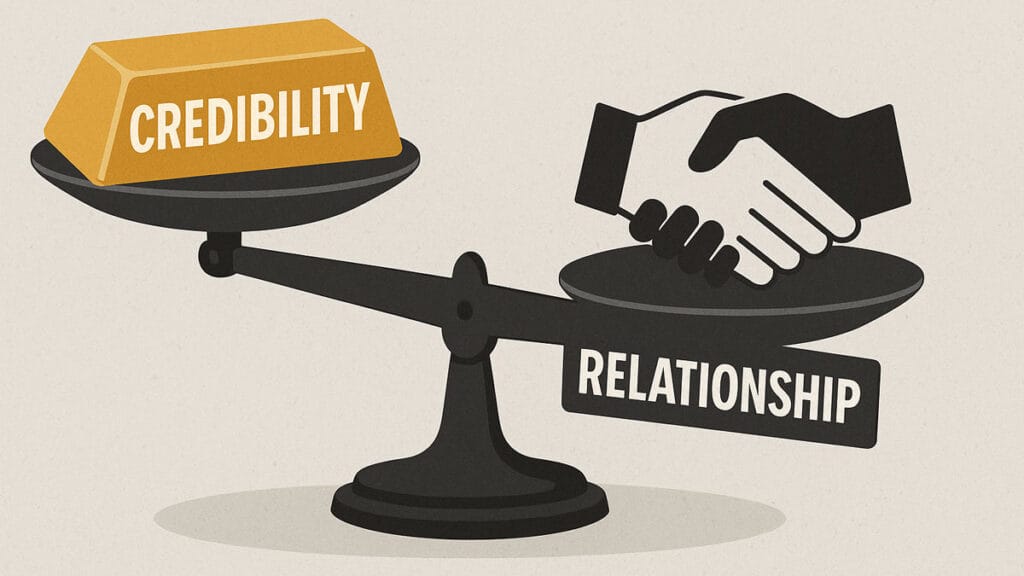


Enterprise sales has changed.
- Not gradually
- Not Subtly
- But fundamentally
There was a time when statements like:
- “I have strong CXO connects.”
- “I regularly engage with CIOs and CEOs.”
- “I can open any door.”
were enough to command credibility.
Today?
They mean nothing without evidence.
Welcome to the new era of enterprise sales —
where proof outweighs promises and impact defines influence.
1. The Market Has Matured
Enterprise buying is now committee-driven, risk-mitigated, and ROI-justified at every stage. Organizations are sharper.
Boards are more accountable.
Investors expect faster and more predictable returns.
Hiring a senior enterprise sales leader is no longer a recruitment decision. It is a strategic investment.
For example, in a recent enterprise hiring mandate, a Sales Manager candidate claimed strong CXO relationships across BFSI.
However, when validated, none of those relationships had converted into enterprise revenue in the past 18 months. Access existed — but measurable impact did not.
When a company offers a premium compensation package, it is not paying for:
- Effort
- Energy
- Confidence
It is paying for:
- Acess
- Influence
- Accelaration
- Revenue Certainity
And certainty cannot be built on verbal confidence.
It must be backed by measurable outcomes
2. The High Cost of Believing Without Verifying
Many organizations have learned this lesson the hard way.
A candidate joins with bold claims of deep C-suite relationships.Compensation is high. Expectations are higher.
Enterprise wins are promised.
But when it’s time to activate those executive connects:
Silence.
- No introductions.
- No decision-maker meetings.
- No enterprise pipeline movement.
The gap between promise and performance is not emotional. It is financial.
In enterprise sales, a senior-level mis-hire can cost 2–3X annual compensation when factoring lost pipeline momentum, delayed market entry, and leadership distraction.
The financial implication goes far beyond salary — it affects strategic positioning.
In today’s competitive environment, companies cannot afford expensive assumptions.
Trust now requires validation.
3. The Rise of Outcome-Driven Hiring
The most important shift in enterprise hiring is this:
The question has changed.
It is no longer:
“Who do you know?”
It is now:
“What revenue did those relationships generate?”
Weak Response: “I have long-standing relationships with multiple CIOs in Manufacturing.”
Strong Response: “I closed ₹18 Cr across 3 Manufacturing accounts by initiating CXO-level conversations that reduced procurement cycles by 40%.”
If you claim C-level access, organizations now expect:
- Documented enterprise deals
- Revenue directly attributed to executive engagement
- Case studies of strategic closures
- References from decision-makers
- Clear mapping from relationship → meeting → opportunity → revenue
The conversation has shifted from:
“I know the CIO.”
to
“I generated ₹10 Cr in 11 months by directly engaging 12 CIOs across BFSI, reducing sales cycle time by 35%.”
That difference separates:
“A relationship-driven seller” from “A revenue-generating strategic asset.”
In our recruitment assessments at Sales & Profit, we ask candidates to walk us through one enterprise deal from first CXO interaction to revenue realisation — including timeline, stakeholder mapping, negotiation complexity, and revenue attribution.
The clarity of this walkthrough often reveals the difference between perceived influence and real impact.
4. The New Sales Professional
Today’s enterprise winners understand something critical:
Influence without impact is noise.
They don’t name-drop.
They demonstrate.
They don’t sell access.
They show conversion.
They don’t rely on perception.
They present performance.
Modern credibility is built on:
- Data
- Documentation
- Deal velocity
- Executive validation
- Pipeline conversion metrics
Sales at the enterprise level has shifted from personality leverage to performance evidence.
Trust is no longer assumed.
It is earned — and verified.
5. The Modern Enterprise Equation
Access → Trust → Influence → Revenue → Expansion
- Access opens the first door.
- Trust builds conversation.
- Influence shapes the decision.
- Revenue validates credibility.
- Expansion proves sustainability.
Every stage must now be measurable.
That is the evolution of enterprise selling.
6. Why This Shift Is Good News
This transformation strengthens the industry.
- It filters exaggeration.
- It rewards substance.
- It protects organizations from costly hiring mistakes.
- It elevates genuine performers.
Professionals who truly command executive trust — and can prove financial impact — will now stand out more clearly than ever.
Merit is becoming visible.
And that is progress.
For hiring leaders, this means executive references must validate revenue outcomes — not just personal rapport. Influence must show up on financial statements, not just LinkedIn endorsements.
7. Final Thought
In modern enterprise sales:
Confidence opens conversations.
Credibility sustains relationships.
Proof closes the deal.
The era of storytelling is fading.
The era of measurable influence has begun.
At Sales & Profit, we believe the future belongs to revenue leaders who can document their impact — not just describe it.
If you’re a sales professional, start tracking your executive engagement outcomes.
If you’re a hiring leader, start validating influence with evidence.
Because in today’s boardroom:
Proof is not optional.
Proof is power.
Stay strategic.
Stay measurable.
Stay profitable.