


Say you need two chairs for a new cabin.
You know the size. You know the budget. You have about ninety seconds you are willing to spend on this. You walk in, you pick, you pay, done.
Now say you are setting up a whole new office. Two hundred chairs this time.
There is a budget to justify to your CFO. An HR team worried about back pain complaints down the line. A facilities head worried about delivery timelines.
Same product. Completely different sale.
This, in a nutshell, is why one selling style never works for everything.
Sales is not a one-size-fits-all game.
Transactional selling, consultative selling, solution selling, and value selling are four different approaches.
Each has its own goal, its own pace, and its own place.
In my sales consulting work, this question comes up all the time. “What’s actually the difference between all these terms we keep hearing?”
So in this blog, let me walk you through it, plainly.
Transactional Selling
Transactional selling is quick. The goal is simple – close the deal, with as little friction as possible.
This works best for low-cost, low-risk products. The kind the customer already understands well. Think of our two-chair example. The buyer already knows what they want.
Here, the customer’s actual need is barely part of the conversation. The focus stays on price, features, and speed. A discount or a quick promotion is often enough to seal it.
There is nothing wrong with this, by the way.
Not every sale needs to be an emotional journey. Sometimes the customer genuinely just wants it fast and easy.
Consultative Selling
Consultative selling is the opposite pace entirely. Slower, deeper, and built around a relationship, not just a transaction.
This is the approach for high-cost, high-risk products. The kind where the customer is not fully sure yet what they actually need. Our two-hundred-chair scenario, for instance.
Here, the customer’s need is the entire focus. A consultative seller asks questions first. Understands the challenges, the goals, the internal politics even. Then works with the customer to shape a solution together.
This is also where most B2B complex sales actually live. Have you read our pieces on SPIN Selling or MEDDIC?
If yes, you already know how this sounds. Both are simply consultative selling. Just broken down into a repeatable set of questions.
Solution Selling
Solution selling takes this one step further.
It is, in a way, a more focused version of consultative selling. Consultative selling looks broadly at the customer’s whole business. Solution selling zooms in. It focuses on solving one clear problem.
This works well for complex products. The kind where the customer may not even know all their options yet. The seller’s job is to take real time here. Understand the exact problem first. Then build a solution around it.
The difference from consultative selling is subtle, but real. Consultative selling often starts before the problem is even fully defined. Solution selling usually starts once the problem is already known. The real work then is comparing who solves it best.
Value Selling
Value selling shifts the conversation again. This time, toward one specific question. What is this actually worth to you?
A value seller does not just list features. They use real data, real stories, and real numbers to show the impact.
It goes beyond simply pointing at what the product does. It connects directly to the customer’s pain points, and shows a real, countable return.
The goal here is simple. Help the customer see the exact business impact. Show them the return on investment they can expect, once they say yes.
Key Differences Between All Four Selling Approaches
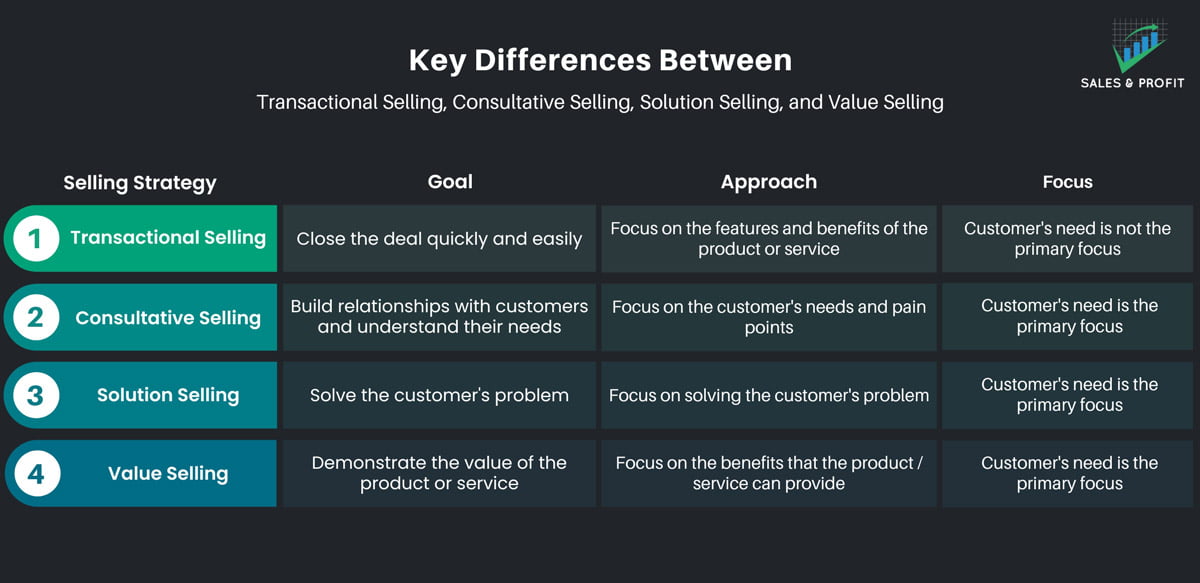
(Click on the image to enlarge it)
FREE Consulting Call to Overcome Your Sales Challenges
Request a 100% free “no obligation” sales consulting call where we will understand your current sales challenges and help you with proven methods to solve those and improve your sales metrics and grow your revenue.
(Already 100+ B2B companies have seen growth in their sales and revenue with us)
The Mistake Almost Everyone Makes
Here is something worth knowing before we go further.
Most sales guys do not fail because they picked a bad approach. They fail because they picked the right approach, for the wrong deal.
Using a transactional pitch on a consultative sale leaves the customer feeling rushed. Sometimes even ignored.
Like a doctor prescribing before the patient has finished describing the symptoms.
And the opposite happens too. Sometimes a seller goes too deep, too slow. The customer just wanted a quick, simple purchase.
To them, it feels like a waste of time. They walked in for two chairs. Not a full needs assessment.
The product does not decide which approach to use. The buyer, and the situation they are in, decides that.
So, Which One Should You Use?
Here is a simple way to think about it –
| If this is true about the deal… | Lean towards… |
|---|---|
| The buyer already knows exactly what they want | Transactional Selling |
| The buyer is not fully sure what they need yet | Consultative Selling |
| The problem is already clear, and a few vendors are competing on who solves it best | Solution Selling |
| The buyer knows the problem, but needs to justify the cost internally | Value Selling |
And one more thing, worth remembering. These four are not boxes you stay locked into for the whole deal.
A single sales cycle can genuinely move through more than one of these.
You might start consultative, uncovering the real problem. Move into solution selling once that problem is clear.
Then close on value selling. This is when you help your champion justify the number to their own boss.
The best sales professionals do not pick just one style and stick to it forever.
They read the room, and they shift.
Additional Tips for Each Strategy
Transactional Selling
Keep your pitch centred on features, benefits, and price. Use discounts or short promotions to move things along.
And be ready to walk away too, if the customer will not meet your price. In transactional selling, that is a perfectly fine outcome. Not every deal needs to be won at any cost.
Consultative Selling
Take the time to genuinely build the relationship. Understand the customer’s needs and pain points before you even think about a solution.
Work with them, not just for them, to shape something that actually fits. And be patient. Consultative deals rarely move fast, and rushing one usually backfires.
Solution Selling
Spend real time understanding the customer’s exact problem before proposing anything.
Then build a solution with them, one that genuinely solves it. Be creative where you need to be, and stay confident in what you are proposing. Half-hearted solution selling is easy for a customer to spot.
Value Selling
Keep the focus on the benefits your product genuinely delivers. Back it up with real data and real customer stories. Not just claims.
Be ready for tough questions on ROI, because they will come. And bring genuine enthusiasm. If you do not sound convinced of the value, your customer certainly will not be either.
Key Takeaways
The best sales strategy for you depends on three things.
- The product or service you are selling.
- The needs of your customer.
- And, to some extent, your own natural style as a seller.
Coming back to our chairs – two chairs for a cabin, or two hundred for a new office.
Same product. Different buyer. Different sale.
So before you walk into your next sales conversation, ask yourself this –
Are you selling chairs today? Or are you selling an office?


